Self-employed expenses

Posted on 19 April 2010 by Comments (15)

We’ve published a few articles lately about what expenses you can claim if you’re an employee.

But what if, like a lot of FreeAgent users, you’re a sole trader or a partner in a partnership, and therefore self-employed, not an employee?

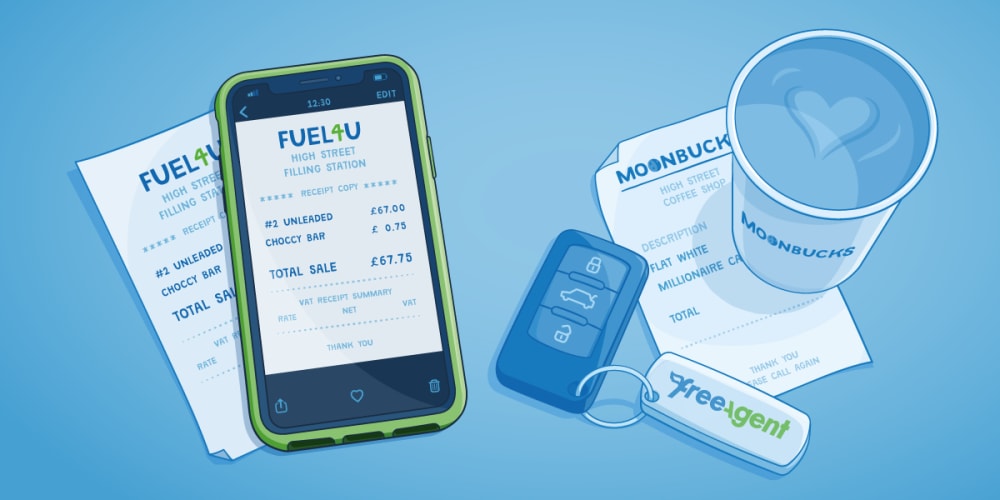
Here’s a quick look at some of the issues relating to out-of-pocket expenses. That means business expenses that you pay for on a personal credit card or using cash out of your own back pocket, that you’d like your business to pay you back for.

There’s no legal difference

When you’re a sole trader or a partner, there’s no legal difference between you and your business.

Legally, you are the business.

This has ramifications about what can happen if, heaven forbid, your business goes down the tubes.

But it’s also important in this area.

Because legally you are the business, there are no tax implications of money you take out of, or put into, the business.

What?

Yes, you did read that correctly.

When you’re a sole trader or a partner, you can take out as much cash as you like from the business account and HM Revenue won’t come after you.

That’s completely different from employees (which includes directors of a limited company). Employees and directors are subject to restrictions as to how much, and how, they can be paid. You aren’t.

You can buy yourself a private jet, take that money from the business bank account and HM Revenue won’t turn a hair.

They will only get upset if you then put that private jet through the business’s accounts and try and claim tax relief on it.

Or, of course, if you take so much out that you can’t pay the business’s dues and it subsequently goes down the tubes.

So what’s the issue then?

For a sole trader or partner, the main issue is that your business’s accounts mustn’t contain any expenses that aren’t “wholly and exclusively” for the business’s trade.

So if you do buy that private jet, and you use it 50% for business, you can put 50% of the costs of running the jet through the business’s accounts.

But the other 50% is private expenses and must be kept out of the business’s accounts - or alternatively, if you put it in, you must add it back as “disallowable” expenses when you do your tax return.

This is because you’re not entitled to reduce your tax bill for any private expenses.

How do I deal with private expenses in my accounts?

If you do spend any money from your business account for private expenses, like your weekly food bill from the Co-op (a bit more realistic than a private jet!), you must explain that as Drawings in your accounts.

In FreeAgent, that means you explain the payments as Money Paid to User > Drawings.

When you’re a sole trader or partner, you’ve got to put any money you take out of your business account as Drawings. That includes not only private expenses, but also any regular wage-like sums that you take out (sole traders and partners aren’t employees, so can’t go on the payroll and be paid a wage).

And it also includes any money you pay into a pension.

Drawings are kept out of your business’s profit and loss account so that you don’t claim tax relief on them by mistake.

In FreeAgent, you’ll find them at the bottom of your balance sheet.

HM Revenue’s recently enhanced penalty regime means they can come down hard on any businesses who haven’t kept full and accurate records, which includes keeping track of what costs count as business and which ones as private.

They say:

“You should be able to show clearly what you have spent personally and what you have spent on business.”

So make sure you explain your costs correctly in your books.

What business expenses don’t count as “wholly and exclusively”?

There are some areas where you have to be careful.

If you spend money on something that’s for mixed business and private use, then unless you can accurately identify part of it that’s just for business and part that’s private, you can’t put any of the cost through your business accounts. It’s all got to go to Drawings.

HM Revenue call this the “dual purpose” test. If you had a personal reason for incurring the expense, even if you also had a business reason for it, then the expense would be disallowed in its entirety - unless it could be accurately split between part that was for business and part for private.

For example, buying ordinary clothes will nearly always fail the dual purpose test and have to go to Drawings, because you can’t distinguish between the business and private part of this expense.

That applies even if you buy a business suit that you wouldn’t wear anywhere else apart from on business. You could wear it elsewhere, so HM Revenue stamp on it. (No, they don’t stamp on the suit. They stamp on you claiming tax relief on it.)

On the other hand, protective clothing, or a uniform, or a “costume” if you’re an actor or other entertainer, would usually pass the test and be OK for inclusion in the business’s expenses.

Travel

There are detailed rules covering travel and accommodation expenses, which are perhaps the most frequent potentially “dual purpose” expenses.

Guidance from HM Revenue starts here.

Summary

If you’re a sole trader or a partner, then you’re not subject to the same restrictions as employees (including company directors) when it comes to taking money out of the business, because legally you are the business.

But you must still make sure you put anything you draw out of the business, which includes private expenses, to the correct place in your accounts - which is almost certainly Drawings.

Disclaimer: This article is for general guidance only and is no substitute for taking professional advice related to your own circumstances.

Over to you...

Tamlyn, Thu April 22, 2010
What about stuff like phone and internet? I mostly use my home broadband for work but I also use it outside of business hours. As it's a fixed monthly cost it's hard to break down how much of it is a business expense. Currently I've been claiming 50% of my broadband and 50% of my mobile phone contract as business expenses. Is that unwise?
emily, Thu April 22, 2010
Hi Tamlyn,

I'd probably suggest you ask your accountant, if you have one, what he/she recommends you do here.

Kind regards,

Emily
Dave Ellis, Sun June 06, 2010
Presumbaly drawings only apply if you actually use a business bank account?
emily, Sun June 06, 2010
Hi Dave,

That's right - if your bank account is marked as personal in FreeAgent, then you'd only explain the business transactions, and leave any others (including drawings) as unexplained.

Kind regards,

Emily
Daniel Hawkes, Tue June 08, 2010
I am a consultant and need to keep up to date.
I paid to attend a course to understand web design so that I could exploit the acquired skill in the business. Similarly, I have been paying for training material related to marketing and selling via the internet. Can I claim relief for these expenses?
Dan
emily, Tue June 08, 2010
Hi Daniel,

Given you've asked on this post, I'm assuming you're self-employed, not an employee - the rules are different!

When you're self-employed, the rule of thumb is that you can claim tax relief on expenses that are "wholly and exclusively for the purpose of the trade".

(That bit of accountantese just means you can claim business expenses only - and it is a more relaxed definition than for employees.)

My own opinion is that yes, you should be able to claim tax relief for these expenses, but that is just my opinion and I would advise you to talk to your own accountant to be 100% sure.

Kind regards,

Emily
Dave Ellis, Sat July 17, 2010
I'd really like to see a definitive list of expenses that freelancers can claim (written in plain English!), I've scoured the net plenty of times looking. So many questions about expenses! Can I claim mileage and petrol if I'm on a long contract that requires me to work on-site?
emily, Sat July 17, 2010
Hello Dave,

As you're a self-employed individual the answer is almost certainly yes.

The reason why nobody has published a "definitive guide" is that there are so many "ifs" and "buts" and grey areas where expenses are concerned!

But it sounds like this would be a very valuable resource - a series of web articles about the different types of common expenses?

We do have a brief guide here in our knowledge base http://www.freeagent.com/support/kb/expenses/expense-types-and-explanations

Kind regards,

Emily
Dave Ellis, Sat July 17, 2010
Hi Emily,

Thanks for the response, the link was useful and I hadn't seen it before.

There are numerous articles that touch on expenses, and while I understand it could be difficult area to cover, particularly as you mention there are so many 'ifs' and 'buts' I do think a post that delved a little deeper and perhaps made clear some of the grey areas would be very popular.

I tried the HMRC site but it may as well be written in a foreign language!
emily, Mon July 19, 2010
Hi Dave,

Thanks very much and I'll certainly bear that in mind!

Kind regards,

Emily
Michael Gwatkin, Mon July 19, 2010
This has been a useful piece of advice and cleared some things up.

I do have one major problem I am struggling to get my head round regarding my business and that is keeping my financial records in order.

I understand to split the personal usage and business basically by percentage and have been doing so.

My biggest conflict is how this information can be interpreted in the easiest way to follow in my financial records. I currently do all my own accounting and it is very messy. A few tips on how to separate Business and Personal expenditure on paper without having to dig through a pile of paperwork and e-mails when I need to would be great.

Is there any advice you can offer on this?
emily, Mon July 19, 2010
Hello Michael,

I'm glad the article's been useful for you.

Are you looking for advice on how to keep your paper records, please, or how to split business and personal transactions on FreeAgent - or are you concerned as to whether, for example, you'd have to trawl through all your phone bills to pick out the business calls from the personal ones?

Kind regards,

Emily
Yvette, Fri July 30, 2010
Taking into account your earlier comments am I right in assuming that a partnership or Sole Trader would be liable for Tax on the net profit before drawings in a fiscal year?

Thanks

Yvette
emily, Fri July 30, 2010
Hi Yvette,

It's an accounting year, rather than a fiscal year (often the two are one and the same for partnerships and sole traders, but some businesses prefer to prepare their accounts to a different date, e.g. 31st December, each year).

Apart from that, yes, that's right!

Kind regards,

Emily
Claire, Wed October 27, 2010
My husband is a sole trader and was declared bankrupt in July 2009, as from that date we had to deregister from VAT and paid no Tax in 2009/2010, the business continued trading and our year end is 31st March, as so much was written off I have started my accounts again from scratch (sage). We were not allowed a business bank account until Aug 2010 so everything had to be put through my personal account, how do I reconcile the bank account if I ignore all personal items, and if my net profit is say £18000 and my drawings were £30000 what do I pay tax on??
(Comments closed)

Recent Posts

Twitter Love

  • Thanks to @freeagent I will never need to use the crappy HMRC payroll software come April.

  • all sorted and ready for PAYE RTI thanks to @freeagent awesomeness.

  • The latest reason why I continue to love @freeagent http://t.co/nfYqVJDfa4 HMRC chucks a stress out at businesses, FreeAgent bats it away!

  • Those folks @freeagent do it right. The confirmation mail includes important information: http://t.co/HCHIvgjpI0

  • @NickClement @freeagent its excellent for invoicing, very flexible & easy - esp billable time by task from timeslips-capture the revenue!

Follow:

The crystal ball predicts a future without stress or frustration

Try FreeAgent for Free