Skip to main content
 UK VAT accounting schemes
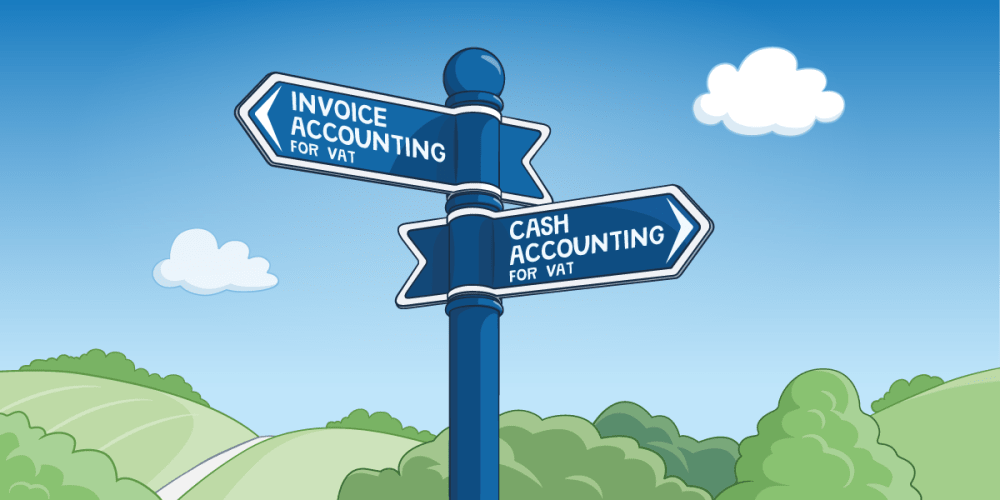
If you’re registered for VAT you’ll need to use one of two VAT accounting schemes: invoice accounting for VAT or cash accounting for VAT. So what do these schemes involve and what’s the difference between them?
Invoice accounting vs cash accounting
Invoice accounting, sometimes called standard accounting, means that you have to pay VAT to HMRC as you raise invoices.
Cash accounting means that you only have to pay VAT to HMRC when your customers pay you. Cash accounting can be better for your cashflow, because you won’t have to pay HMRC any VAT until your customers have paid you.
Let’s take an example:
On 1st February a business issues an invoice to a customer for £1,000 + VAT (a total of £1,200). The VAT is charged at the standard rate of 20%, so the business will have to pay £200 to HMRC.
The customer pays the invoice on 1st April. Because this particular business prepares its VAT returns to 31st March, 30th June, 30th September and 31st December each year, this means that while the invoice (dated 1st February) fell into the quarter that ended on 31st March, the payment falls into the quarter that ends on 30th June.
If the business uses the invoice accounting scheme, it must include the £200 from the invoice on its March VAT return and pay it to HMRC by the deadline for the return - usually one month and seven days after the end of the accounting period (7th May in this example).
However, if the business uses the cash accounting scheme, it won’t have to include the £200 until its June VAT return, because that was the period during which the customer paid the invoice. As a result, the business owner won’t have to pay the VAT to HMRC until 7th August.
Bills from your business’s suppliers
If you use the invoice accounting scheme, you can reclaim input VAT (the VAT paid to suppliers when you buy from them) for the period during which your supplier invoices you.
If you use the cash accounting scheme, you can’t reclaim any input VAT until you pay your supplier.
If you tend to pay your bills promptly, it won’t make a big difference whether you’re using invoice or cash accounting. However, if your customers always pay you immediately, then you may be better off sticking to invoice accounting so that you can reclaim the VAT promptly on your bills from your suppliers.
VAT accounting when customers don’t pay
If you have a bad debt (i.e. a customer doesn’t pay you for a particular invoice), then the way you need to handle this depends on which method you use to account for your VAT.
If you use the cash accounting scheme, the VAT on the invoice is not due to HMRC until the customer has paid you.
But if you use the invoice accounting method then you would have paid the VAT to HMRC during the quarter in which the invoice was raised. As you’re not going to be paid the VAT back by your customer, you can try to reclaim that VAT back from HMRC as bad debt relief - but there are conditions.
For example, you can only claim back bad debt relief on debts that are more than six months old - even if you know for certain before that time that your customer won’t pay you (for example, if they’ve gone into liquidation).
Payments received before an invoice
If a customer pays you before you have invoiced them, you are liable to pay the VAT at the point the customer paid you even if you’re using the invoice accounting scheme for VAT. This is because a payment from a customer creates a tax point (i.e. a point at which VAT becomes payable).
Cash accounting and the VAT Flat Rate Scheme
If your business is registered for the VAT Flat Rate Scheme, then there is a different “cash-based method” that you can use. Instead of adding up all your sales invoices, using this method you’d add up all the money your customers paid you for that quarter.
Eligibility for cash accounting
The cash accounting scheme is aimed at smaller businesses, so in order to be eligible your estimated VATable sales for the next 12 months must be no more than £1.35 million.
Once you’ve joined the scheme you can stay on it until your annual VATable sales exceed £1.6 million.
You can’t use cash accounting if:
- you’re behind with your VAT returns or payments
- have been convicted of a VAT offence
- have been charged a penalty for VAT evasion in the last year
Leaving the cash accounting scheme
You can only leave the cash accounting scheme at the end of a tax period. After you have left the scheme, you must then use the invoice accounting method from the beginning of the next tax period. HMRC provides detailed information on leaving the scheme in section 6 of VAT Notice 731, but remember to speak to an accountant if you’re in any doubt.
Disclaimer: The content included in this guide is based on our understanding of tax law at the time of publication. It may be subject to change and may not be applicable to your circumstances, so should not be relied upon. You are responsible for complying with tax law and should seek independent advice if you require further information about the content included in this guide. If you don't have an accountant, take a look at our directory to find a FreeAgent Practice Partner based in your local area.
30th June 2021