Skip to main content
 Working from home? Learn which expenses you can claim
If you’re one of the many self-employed people in the UK who carries out work from their own home, there’s some good news for you. You’re entitled to include part of the running costs of your home in your accounts, which will save you some tax. Here’s how to work out how much you can claim.
Two methods for calculating business use of home
If your business is eligible to use the new simplified accounting method, you have a couple of options for working out how much to claim for business use of home.
If you’re a sole trader or in a partnership where all the partners are individuals rather than limited companies, you’re eligible to use the simplified accounting method. One option this method of accounting allows is a flat rate calculation for business use of home.
The flat rate method
The flat rate method simply asks you to look at how many hours a month you spend running your business at home, on average, and include a fixed amount in your accounts for business use of home.
The amount varies with the number of hours per month you work at home, as follows:
- 25-50 hours: £10 per month
- 51-100 hours: £18 per month
- 101 hours or more: £26 per month
Using this method will certainly be quicker than working out your actual costs. However, the figure might not be as high meaning that you could save time but pay more tax. It’s also important to note that the flat rate method covers only costs for heat, light and power - you will still need to work out how much you can claim for your other costs, such as rent, council tax, and telephone and broadband.
The costs method
If your business is a limited company, you’re not eligible to use the simplified accounting method and you’ll have to use the costs method. HMRC has said it won’t challenge claims of up to £6 per week, or £26 per month if you are paid monthly, though strictly speaking this is not the same as using the simplified accounting method. The amount you can claim using the costs method depends on the type of business you have and what work you actually do at home.
For example, if you’re a freelance decorator you might spend an hour or two a week writing up your books at home, but spend the rest of your working life at your customers’ properties. But if you’re a self-employed PR consultant or web designer, you may well do the vast majority of your work at home and only occasionally visit clients.
HMRC says that you need to apportion the running costs of your home on a “fair and reasonable” basis between the private element of that cost - the part that relates to you actually living there - and the business element. But how do you do this?
One method is to work out how many rooms you have in your home and identify how many of those rooms you use for business - and also calculate how much time you actually spend using these rooms for business.
Say there are 10 rooms in your home. You only use one for business, and 90% of the use of that room is for business. You would add up all the costs that you can claim (see below), divide by 10 and then calculate 90% of that figure in order to get the accounts figure for the business use of your home.
Bear in mind that if you use any part of your home solely for business activities, capital gains tax will be due on that part if you sell your home.
What running costs can you include in your accounts?
Here are some of the costs you might incur to run a home, part of which you may then be able to claim in your business accounts:
Mortgage
If you’re self-employed and buying your home through a mortgage, you can claim a proportion of the interest only - not the capital repayment.
Rent
You can’t charge your business rent when you’re self-employed, because legally you are the business. But if you’re renting your home from a landlord, then you can claim a proportion of the rent for your business.
Council tax
You can claim a proportion of your council tax cost. However, depending on how much you use your home for business, you may have to pay business rates rather than council tax.
Light and heat
You can claim the business proportion of your gas and electricity costs for lighting and heating in the room(s) you use for business.
Telephone and broadband
Remember that what you can claim for your telephone and broadband is not apportioned on the basis of the number of rooms in your home, but on what your actual usage of the line is.
You can claim the full cost of all your business use of the line, and a percentage of the line rental, based on how much you use it for business purposes and how much is for personal use.
Property repairs
If a property repair relates solely to the part that’s used for business, you would include this cost in your accounts in full, subject to the business use of that room.
For example, if the ceiling in your office/music room was repaired for £200, you wouldn’t need to divide that by 10 because the repair was only for that room – you would just multiply by 90%, and include that amount (90% x £200 = £180) in your accounts.
If the repair is to the whole house, for example a repair to the roof, you can include that in the same proportion as you would the rent or council tax – so in the example above of your 10-room house, this would be 90% of one-tenth of the repair cost.
If the repair is just for a part of the house that’s not used for business - such as replastering of a kitchen - then you can’t claim any part of that repair in your business accounts.
Water
If you use a lot of your home water supply for business - if you run a car valeting service, for example - then you would need to apply to the water company for this to be separately charged. You could then claim the full cost. If you don’t use a significant amount of water for your work, you can’t claim any of the cost for your business.
Recording business use of home costs in FreeAgent
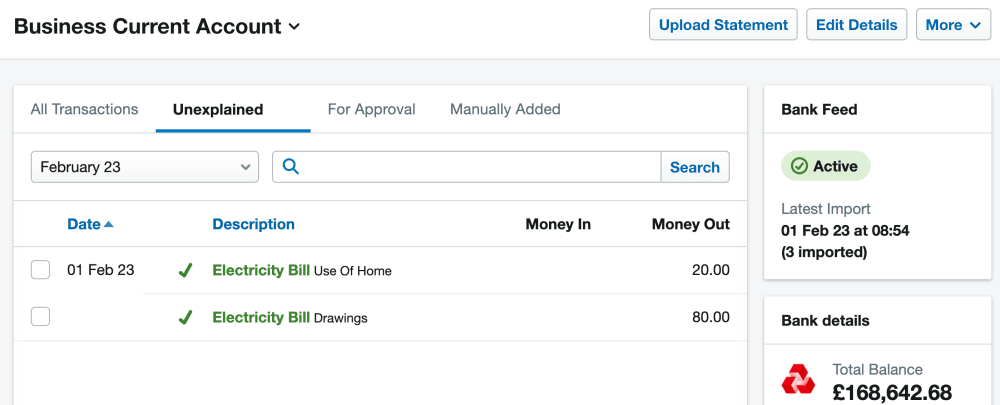
FreeAgent makes claiming business use of home expenses easy by enabling you to split the relevant bank transaction (for example, for an electricity bill) so that only the proportion that you can claim as a business cost is recorded as an expense in your accounts.
Find out more about managing expenses the easy way in FreeAgent.
If you’re in any doubt as to what you can claim, you should seek further advice from an accountant.
More expenses tips:
- Travel expenses and mileage
- Entertaining expenses
- Clothing expenses
- Scanned receipts and HMRC
- Managing expenses in FreeAgent
Disclaimer:The content included in this guide is based on our understanding of tax law at the time of publication. It may be subject to change and may not be applicable to your circumstances, so should not be relied upon. You are responsible for complying with tax law and should seek independent advice if you require further information about the content included in this guide. If you don't have an accountant, take a look at our directory to find a FreeAgent Practice Partner based in your local area.
29th August 2024