Skip to main content
 Sole trader or limited company: which is best for you?
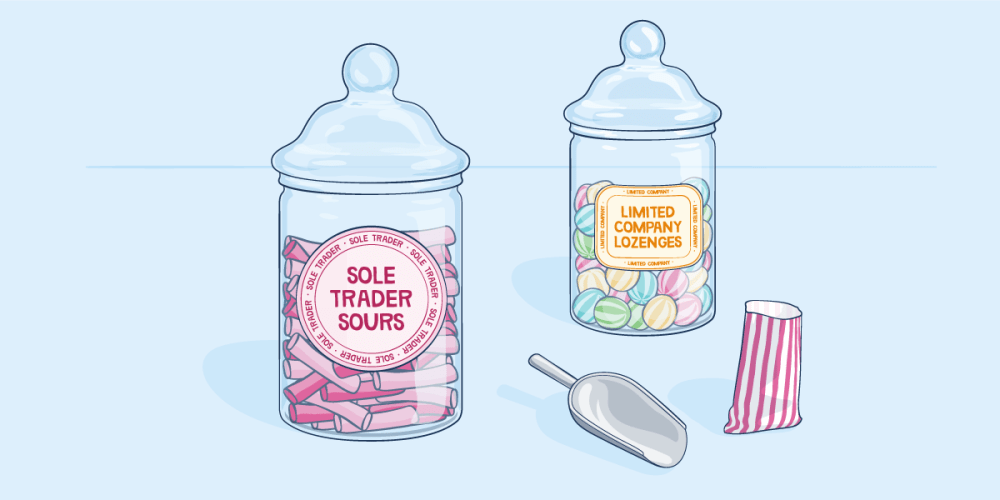
If you’re a sole trader, you may have heard that you can save tax by running your business through a limited company. This could indeed be the case, but there are many factors you should consider before you decide.
In this guide, we’ll take a look at the advantages and disadvantages of turning your business into a limited company (this is also known as ‘incorporation’).
The big differences: a quick summary
Before we dive look at these advantages and disadvantages in more detail, let’s cover off the biggest differences between being a sole trader and forming a limited company:
Liability for business debts
Sole trader: You have unlimited liability, meaning personal assets can be used to pay off business debts.
Limited company: You have limited liability, meaning your personal assets are protected from being used to pay business debts.
Tax implications
Sole trader: Sole traders typically pay Income Tax and National Insurance contributions.
Limited company: Limited companies pay Corporation Tax on company profits.
Legal formalities
Sole trader: There are minimal legal formalities in becoming a sole trader, and the process often requires only a simple registration with HMRC.
Limited company: Forming a limited company involves a more complex setup process, including registration with Companies House and additional legal requirements.
Let’s look in more detail at the advantages and disadvantages of forming a limited company:
Advantages of incorporation
Switching from sole trader to limited company could save you tax
There could indeed be some tax savings to be made by making the switch from a sole trader to a limited company. While sole traders pay Income Tax on profits and classes 2 and 4 National Insurance, limited companies pay Corporation Tax on profits, which is a lower rate than Income Tax, and no National Insurance.
Limited companies don’t generally have to make Income Tax payments on account, but sole traders do. While this is not in itself a tax saving, the timing of the payments on account can sometimes cause cashflow issues for some businesses.
It’s important to discuss any potential tax savings carefully with your accountant and to ask them to calculate what you could save. This will depend on your business’s circumstances, and, in particular, whether you have any other sources of income.
Limited companies may attract investment more easily
If you are looking for investment in your business, incorporation could be an advantage for you. As a limited company, you should be able to sell shares in your business to an investor relatively easily.
Sole traders, on the other hand, cannot seek investment, unless they go through the complex process of turning their business into a partnership.
You would have limited liability protection
Limited liability is a form of legal protection that prevents individual company directors from being held personally responsible for their company’s debts or financial losses. Because a limited company is a separate legal entity from its directors, the company can own equipment, incur debts and pay bills in its own right.
That means that if the company is ever sued, your own personal assets, such as your house and car, cannot generally be seized to pay the debt, unless, for example, you have given a personal guarantee to a company creditor or you have deliberately not paid your tax debts.
If you are a sole trader, on the other hand, your own assets could be seized to pay a business debt, because you and the business are legally the same entity.
Disadvantages of incorporation
Running a limited company means more paperwork
Sole traders have to file a personal tax return to HMRC each year. However, a limited company has to file:
In addition, each director nearly always has to file a personal tax return to HMRC.
If you are an employee of your company and take a salary, you will also have to register the company as an employer and set up payroll. You will need to report to HMRC in real time whenever the company pays one of its staff. You won’t need to do this as a sole trader unless you recruit employees other than yourself.
All this means that after incorporation you - or your accountant - will have to spend more time preparing and filing paperwork.
As the director of a limited company, you will have legal duties to fulfil
Your legal responsibilities as company director would include safeguarding the company’s assets and making the decision to cease trading if you knew the company couldn’t survive. If you fail in your legal responsibilities as a director, the consequences can be serious: you could be fined or even go to prison.
Trading through a limited company involves potential tax costs
As the director of a limited company, you would no longer be able to draw money out of your business bank account freely. The company could pay you a salary and/or pay dividends on the shares you own. However, these would be taxable after taking into account your Personal Allowance and Dividend Allowance.
Another potential tax implication is that when a limited company makes a loss, it can only use that loss against its own profits. Sole traders, on the other hand, may be able to use some of the loss that their business makes to save tax on their other income. For example, if a sole trader is also employed elsewhere, they may be able to use their business losses to reduce the tax they pay on their employment income.
Limited companies have less privacy than sole traders
When you file your company’s accounts and confirmation statement, these documents will be in the public domain, and available for anyone to see on sites such as Companies House and DueDil. This means that your company’s figures will be visible to the public, along with its office address (although you could make this your accountant’s office, rather than your own home).
Other things to consider
As a sole trader, depending on your circumstances, you may be able to take advantage of the trading allowance, a tax exemption of up to £1,000 a year. You’ll also use cash basis accounting by default, and you may be able to use flat-rate simplified expenses to calculate some business costs, such as working from home and vehicle expenses. These schemes cannot be used by limited companies.
Sole traders and partnerships have to pay Capital Gains Tax on profits from selling business assets, and there are various tax reliefs available that may enable them to reduce or delay the amount of tax they have to pay. These tax reliefs do not apply to limited companies, which instead have to pay Corporation Tax on profits from selling their assets.
Weighing up the pros and cons
As you can see, when it comes to deciding whether or not to incorporate your business, it’s not a clear-cut choice. The best decision for your business will depend on your own circumstances and you should discuss it with your accountant.
Get FreeAgent for free
Whichever business type you choose, you could access FreeAgent’s award-winning accounting software free of charge.
If you have a business current account from NatWest, Royal Bank of Scotland or Ulster Bank, you can access FreeAgent for free for as long as you retain your account (optional add-ons may be chargeable).
Disclaimer: The content included in this guide is based on our understanding of tax law at the time of publication. It may be subject to change and may not be applicable to your circumstances, so should not be relied upon. You are responsible for complying with tax law and should seek independent advice if you require further information about the content included in this guide. If you don't have an accountant, take a look at our directory to find a FreeAgent Practice Partner based in your local area.
13th November 2024