Skip to main content
 MTD for Income Tax: everything you need to submit your quarterly updates and final declaration
Not sure what information you need to make quarterly updates and submit your final declaration under Making Tax Digital (MTD) for Income Tax? We’re here to help you navigate the new process as smoothly as possible.
In this guide, you’ll learn all about the information you’ll need to gather to get started. We’ll also explain the financial data you’ll need to report to meet your new obligations.
The information you need to start MTD reporting
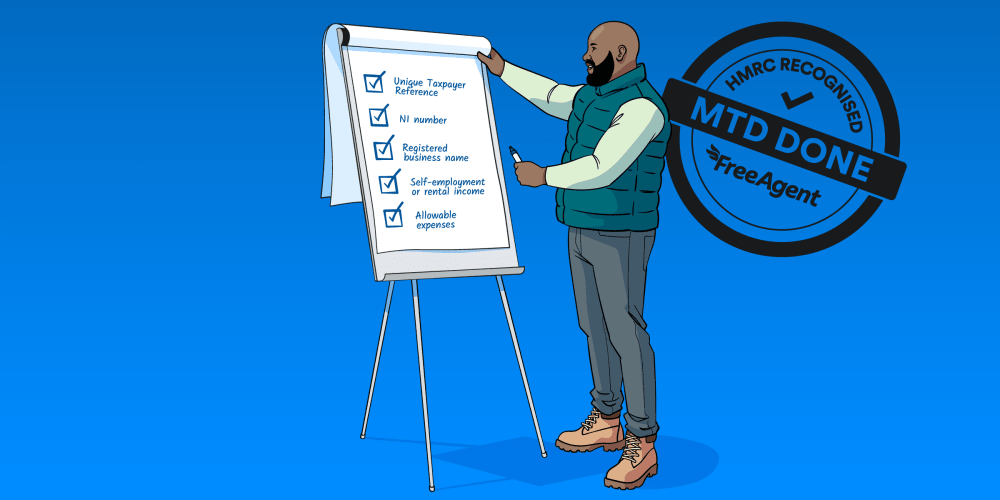
Whether you’re making a quarterly update or submitting your final declaration, you need to have the following information to hand to complete the process.
| Information you'll need | Where you can find it |
|---|---|
| Your Unique Taxpayer Reference (UTR) | Most correspondence from HMRC |
| Your National Insurance number | Most letters about tax, pensions or benefits, or any payslip |
| Confirmation from HMRC that you’ve signed up for Making Tax Digital for Income Tax | Confirmation screen after you finish the registration process |
| Your registered business name and address (if you’re a sole trader) | Relevant correspondence from HMRC |
You also need to have HMRC-recognised MTD software, like FreeAgent, set up and connected to your HMRC account. Before you prepare to make any submissions, check your software settings to confirm:
- you have an active MTD connection in place
- the connection is to the correct HMRC account
- the connection is for the correct income stream, if you have multiple income streams (e.g. two sole trades, or you are a sole trader and also a landlord)
You then need to get your financial records ready to provide the information HMRC requires in your quarterly updates and annual final declaration.
What do you need to report in your quarterly updates?
Quarterly updates are about reporting your income and expenses for the period, not working out how much tax you owe.
Each quarter, you’ll send HMRC a summary of your figures for each income stream. If you have both self-employment and property income, you’ll submit a separate update for each.
If you run more than one business, you’ll need to provide separate income and expense totals for each business.
Note: Once you’ve signed up for MTD for Income Tax, you have to submit a quarterly report for every quarter, even if there’s no income or expenditure to report. If this is ever the case, you should enter zero (‘0’) figures in the relevant sections.
Self-employment or rental income figures
When reporting your quarterly income, you’ll need to provide figures for each income stream, based on how your business or property income is set up and the accounting method you use.
- For each self-employed business: you will need to add up the income you earned, or received, during the quarter, depending on the accounting method you are using.
- For UK property income: you will typically add up all the rent payments you received across your rental properties during the quarter. Report this as a single figure against your property income stream.
Your accounting basis determines which income you should include in each quarterly update:
- If you’re using cash basis accounting, you report income based on when the money actually came in. This means you include payments you received during the quarter, even if the invoice was issued earlier or later.
- If you’re using accruals basis accounting, you report income based on when it was earned. This means you include income from invoices dated in the quarter, even if you haven’t been paid yet.
You can check which accounting method you’re using in your accounting software, or confirm it with your accountant or bookkeeper if you’re unsure.
Allowable expenses
Alongside your income, you need to report your total allowable expenses for the quarter.
Allowable expenses are most of the day-to-day costs of running your business or rental property. HMRC allows you to include these costs in your taxable profit calculation to reduce the amount of income you pay tax on.
Note: If you claim the trading allowance or property income allowance instead of allowable expenses, you can report these - along with other adjustments and tax reliefs - either as part of your quarterly updates or in your final declaration.
For self-employed business owners, allowable expenses might include:
- office costs (e.g. rent you pay for business premises, stationery, phone bills)
- travel costs (e.g. fuel, parking, train, bus tickets)
- staff costs (e.g. staff salaries, subcontractor costs)
- financial costs: (e.g. insurance, bank charges)
- costs of your business premises (e.g. heating, lighting, business rates)
- marketing costs (e.g. money spent on advertising your business)
For unincorporated landlords, allowable expenses might include:
- maintenance and repairs to your property
- water rates, council tax and utilities such as gas and electricity
- relevant insurance policies, such as buildings, contents and public liability insurance
If your income is under the VAT threshold (currently £90k per year), you can file ‘consolidated expenses’ for each source of income. This means you only have to provide one total figure for your allowable expenses in that income stream.
If your income is higher, you must group expenses for each income stream into categories like ‘cost of goods or stock,’ ‘office costs’ and ‘travel and vehicle costs’.
Further reading: You can learn more about which expenses you can claim for as a self-employed business owner in our A-Z of expenses. If you’re a landlord, you can read our guide to allowable expenses for landlords.
If you’re unsure about whether or not you can claim for an allowable expense, you should always check with an accountant or bookkeeper before submitting a quarterly update.
What you need to submit your final declaration
The final declaration replaces the traditional Self Assessment tax return. It’s where you report your figures for the entire tax year, including taxable income you don’t report in your quarterly updates, such as dividend income.
Unlike with quarterly updates, you must submit one MTD for Income Tax final declaration each year. This declaration should include the figures from all your income streams - both sole trades and properties.
Business and property figures
For the final declaration, you’ll need to confirm your income and expenses for the whole tax year.
- For each self-employed business: report your total business income for the tax year.
- For property income: report your total rental income for the tax year as a single figure.
You’ll also need to submit your total allowable expenses for the year per income stream, unless you have chosen to claim the trading allowance or property income allowance instead.
Adjustments and reliefs
Your final declaration may also include any adjustments and tax reliefs you claimed during the tax year, or you can claim these as you go.
Depending on your circumstances, these figures may include:
- capital allowances for equipment, vehicles or other assets
- business or property losses
- losses brought forward or carried back
- trading allowance or property income allowance
Other income
Depending on your circumstances, there are several other types of income you might need to include in your final declaration.
If HMRC already knows about certain income you received, such as State Pension or employment income, then part of preparing your final declaration will be to request through your software the figures for how much income you earned from these sources. You need to check that the figures HMRC hold for you are correct, and if they are not, you will be able to amend them as you fill in your final declaration.
Bank and building society interest
You need to declare any interest you’ve received from bank or building society accounts, so make sure you have your interest statements or certificates to hand. If you don’t already have these documents, you can request copies from your bank or building society.
If your bank or building society account is a joint account, you only need to declare half of the interest received in the tax year.
You don’t need to declare interest received from ISAs (Individual Savings Accounts), as they are tax-free accounts.
Dividends
If you receive dividends from any shares you hold, you need to declare this in your final declaration.
Income from pensions and benefits
Your State Pension income will come through from HMRC but you will need to declare your income from any private pensions, since HMRC won’t yet know about that.
If you have a private pension, your pension provider will usually tax the payments before they pay them out and send you a P60 detailing the amounts that were deducted.
You also need to check HMRC’s figures for any taxable state benefits you received during the year, such as:
- Job Seekers Allowance (JSA)
- Incapacity Benefit (from the 29th week you receive it)
- contribution-based Employment and Support Allowance (ESA)
- Carer’s Allowance
Employment income
If you were paid a salary by an employer, you need to know how much you received, how much tax you paid at source, and the employer’s PAYE tax reference. These figures can all be found on your P60 or P45, if you have one, so make sure you have this form to hand. HMRC will send the figures to you as part of the final declaration process, but you need to check that the figures they hold are correct.
Any benefits from your employer
If you received any taxable benefits from your employer in addition to your salary, such as private healthcare or a company car, you also need to report these figures in your final declaration. You can find this information on your P11D form.
Student loan repayments
If you’re repaying a student loan, you need to declare which repayment plan you’re on and how much you repaid during the tax year as part of your final declaration.
You can usually find these details in your loan statements or by checking your Student Loans Company account. To find out more, take a look at our guide to paying back your student loan when you’re self-employed.
Donations to charities under Gift Aid
If you made donations to charities under Gift Aid during the tax year, you need to declare the total amount of Gift Aid donations you made in your final declaration.
Overseas income
You need to declare any taxable income you’ve received from overseas. This includes dividends of more than £500 you’ve received from a company outside the UK.
Income from trusts
If you received any income from a trust, you need to declare it in order to pay the correct amount of tax. The trustee who manages your trust should be able to provide you with an R185 (trust income) form that summarises your income during a particular tax year, if you don’t already have one.
FreeAgent: here to help you get MTD done
This guide has covered what you need to submit your quarterly updates and final declaration under Making Tax Digital for Income Tax. From digital record-keeping to submitting your updates directly to HMRC, FreeAgent is your end-to-end MTD solution. Get MTD for Income Tax done with FreeAgent.
To learn more about MTD for Income Tax, check out our Making Tax Digital hub.
Disclaimer: The content included in this guide is based on our understanding of tax law at the time of publication. It may be subject to change and may not be applicable to your circumstances, so should not be relied upon. You are responsible for complying with tax law and should seek independent advice if you require further information about the content included in this guide. If you don't have an accountant, take a look at our directory to find a FreeAgent Practice Partner based in your local area.