 Skip to main content
 Selling online? 8 top accounting tips for e-commerce

If you’re running an e-commerce business, you don’t need us to tell you you’re already juggling a lot: marketing your products, fulfilling orders and, of course, handling your business finances. When it comes to accounting and bookkeeping, we’re here to make it a little bit easier.
These tips for e-commerce business owners will help you stay on top of your accounting and bookkeeping. And we’ve even got some extra, real-world insight from Jolene Roberts [pictured above], FreeAgent customer and founder of award-winning natural cosmetics brand (and online retailer) Òir Soap.
1. Register your business with HMRC and choose the right legal structure
Once your gross trading income from making or selling products for profit exceeds £1,000 in a tax year, you may need to tell HMRC about your income from online platforms.
You’ll also need to decide how to structure your business. Two common options are to either register as a sole trader or set up a limited company.
- As a sole trader, you and your business would be one and the same, legally speaking. If you were to set up a limited company, you and your business would be separate legal entities.
- Operating as a sole trader usually involves less administration, while limited companies have additional accounting, reporting, and filing responsibilities.
- Sole traders pay Income Tax on their profits, while limited companies pay Corporation Tax and may pay their owner/directors through a combination of salary and dividends.
Our guide to choosing between a sole trader business and a limited company helps you weigh up the merits of each legal structure and consider which could be right for your business.
2. Keep your business and personal money separate
If you set your business up as a limited company, for tax purposes you should set up a business bank account. This is because the company is a separate legal entity to you as an individual.
Sole traders can technically use a personal bank account, but keeping your business transactions in a dedicated bank account will make it much easier for you to maintain accurate records, according to FreeAgent’s Chief Accountant, Emily Coltman FCA. “A separate business bank account is the best way to make sure you don’t confuse your business and personal income and costs, and avoid paying the wrong amount of tax.”
3. Use accounting software to reduce manual admin and build bookkeeping into your daily workflow
Spreadsheets may be sufficient when your business is very small, but they quickly become time-consuming and prone to manual errors as your sales and expenses grow. A more efficient and scalable alternative to spreadsheets is accounting software.
A platform like FreeAgent can save you time by automating tasks such as importing bank transactions, recording expenses, creating invoices, calculating tax, and generating financial reports. When choosing accounting software for your e-commerce business, look for a platform that:
- connects with your bank account and the other tools your business uses
- gives you a clear view of your finances
- makes it easy to collaborate with your accountant
- is HMRC-recognised for Making Tax Digital (MTD) for Income Tax (this is particularly relevant if you are a sole trader)
Jolene Roberts, founder of Òir Soap, recommends FreeAgent. “It’s really straightforward,” she explains. “You don’t have to dig too far to find what you need, and your data is laid out in a way that’s easy to read and understand. If you’ve just started a business, one thing you do have within your control is access to your numbers. Getting on top of them early on will put you in a great position - and FreeAgent makes it really easy to do that.”
FreeAgent can help make bookkeeping part of your regular workflow by bringing bank transactions, expenses, invoices, and supporting documents together in one place. This makes it easier to update your records little and often, rather than saving everything for the end of the month, quarter or even tax year.
Jolene adds: “My accountant says the more organised you can make your accountancy system, the better! If you ever get a tax inspection from HMRC, all the information you’ll need is already there.”
4. Set up a payment system that works for your customers - and your accounts
For any e-commerce business, a robust and reliable system for taking payments is an absolute must. While it’s vital for your system to make it easy for customers to buy from you, it’s also important that it gives you a clear, reliable record of each transaction.
Accurate payment records help you match sales to the money arriving in your bank account, identify fees and refunds, and make sure your bookkeeping reflects what the business has actually earned.
When choosing a payment provider, consider the customer experience alongside the accounting admin it creates. Look for a system that supports the payment methods your customers expect, as well as integrating with your e-commerce platform and accounting software.
5. Streamline your reconciliation and transaction posting process
If you’re selling across multiple platforms, keeping track of all your orders, fees and refunds can quickly become a time sink. Plus, it’s easy to introduce errors when logging into multiple e-commerce platforms and payment portals every month, downloading spreadsheets, and manually reconciling settlements.
But adding an automated process - like FreeAgent’s new integration with Equali - can take the hassle out of the process.
“We know the pain and frustration with keeping your books compliant through Amazon, Shopify, eBay and Etsy,” says Stu McEwan, Principal Product Manager at FreeAgent. “But FreeAgent and Equali have designed a new integration to make your bookkeeping a breeze. All of your sales, all of your costs, are reconciled automatically into FreeAgent across those marketplaces.”
Amazon, Shopify, eBay and Etsy are all supported, and TikTok Shop, Facebook and Instagram are coming soon. Even better, FreeAgent customers get a 20% discount with Equali, so you can get started on those marketplaces from as little as £12 per month. Find out how you can get started with FreeAgent’s integration with Equali.
6. Know your tax and reporting responsibilities
Understanding and meeting your tax and reporting responsibilities is a legal requirement. Complying with these rules means you are well placed to keep the right records, file accurate and timely returns to HMRC , and prepare to pay any tax you owe at the right time. Depending on your business structure and circumstances, you may need to:
- report your income and costs to HMRC, either through Making Tax Digital (MTD) for Income Tax or Self Assessment
- submit VAT returns
- fulfil end-of-year filing responsibilities (for limited companies)
While staying on top of these obligations is vital for compliance, understanding the financial information behind them gives you greater visibility of your business’s performance.
For example, in FreeAgent, the profit and loss (P&L) report allows you to track income, costs, and profitability. Meanwhile, the balance sheet provides a snapshot of your financial position and the Performance Benchmarking report allows you to compare key figures with similar businesses.
For Òir Soap, this visibility was nothing short of game-changing. “This time last year, I thought I was going to have to close the business,” Jolene says. “Really facing my numbers and understanding the reporting in FreeAgent helped me turn the situation around.”
Today, she uses those insights to measure growth and prepare for future investment. “I use the P&L all the time,” she says. “I now know that in the last six months our business has increased by more than 80%. Thanks to FreeAgent, I know that for a fact, and I can find that number really, really quickly.”
Jolene’s 3 top tips for e-commerce business owners
1. Get to know your accounting software - it probably does more than you think!
“Getting to grips with all the functionality in FreeAgent has been quite fundamental to turning my business around because I can track my profit as well as how much tax I’m paying.”
2. Use small pockets of time to stay on top of your bookkeeping.
“If I’ve got a down moment – if I’m sitting on a train or a bus or anything – I’ll log into FreeAgent [on the mobile app] and sort it out because I know that I’ve just got a moment when I can connect a few invoices to it and get caught up.”
3. When times get tough, get comfortable with your numbers.
“If it feels scary and like you’re losing money, that’s the exact time you need to be doing it because knowing your numbers actually makes the situation a lot less scary.”

7. Understand your cashflow picture before committing to major costs
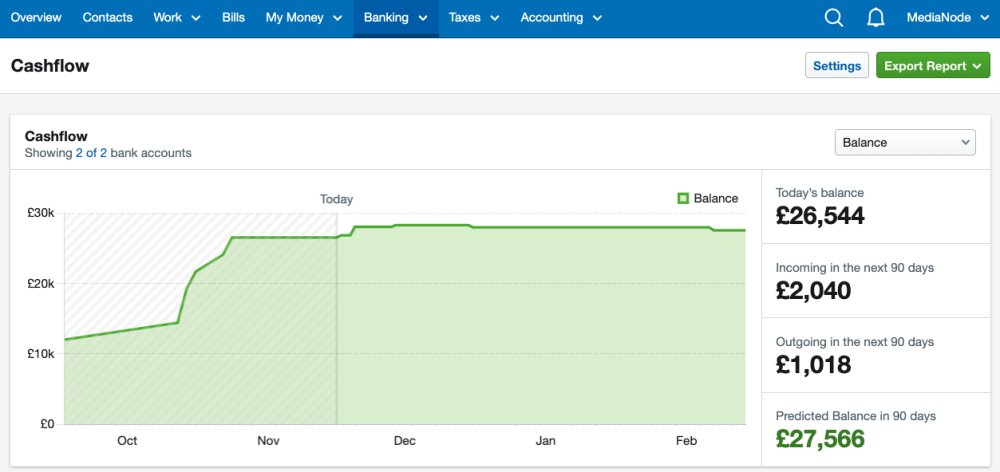
A clear view of your cashflow helps you understand what your business can realistically afford before making a major financial commitment. Cashflow is important for e-commerce businesses because you may need to pay for stock, packaging, marketing and fulfilment before the resulting sales income reaches your bank account.
FreeAgent’s cashflow forecast screen - shown below - provides a visual representation of the money expected to enter and leave your business in the next 90 days. For a longer-term view, you can set up one of FreeAgent’s cashflow forecasting integrations.
Jolene uses a simple test to assess whether her business’s cashflow can support a major new expense. “If you’re thinking about making a big investment - in staff, equipment, or marketing activity, for example - see if you can save the monthly cost in a separate account for three months first,” she explains. “If you’ve been able to do that, you can go ahead. If not, you can’t afford that investment right now.”
8. Keep your inventory records connected to your accounts
Accurate inventory records help you understand how much stock you hold, what that stock cost your business, and how much profit you make when products sell. Keep your purchases, sales, returns, damaged items, and stock adjustments up to date so the figures in your inventory system match your accounting records.
Where possible, connect your inventory management, e-commerce, and accounting systems so transactions flow between them automatically. For example, integrations like FreeAgent’s connection with Turbo Inventory can keep your inventory and accounting records continuously in sync as the information changes.


